Every year, millions of people make the journey to Karbala during Arbaeen to honor Imam Hussain (as), commemorating his sacrifice and renewing their connection to the values he stood for. Along this remarkable route, another tradition quietly makes the journey possible: the tradition of mowkebs.
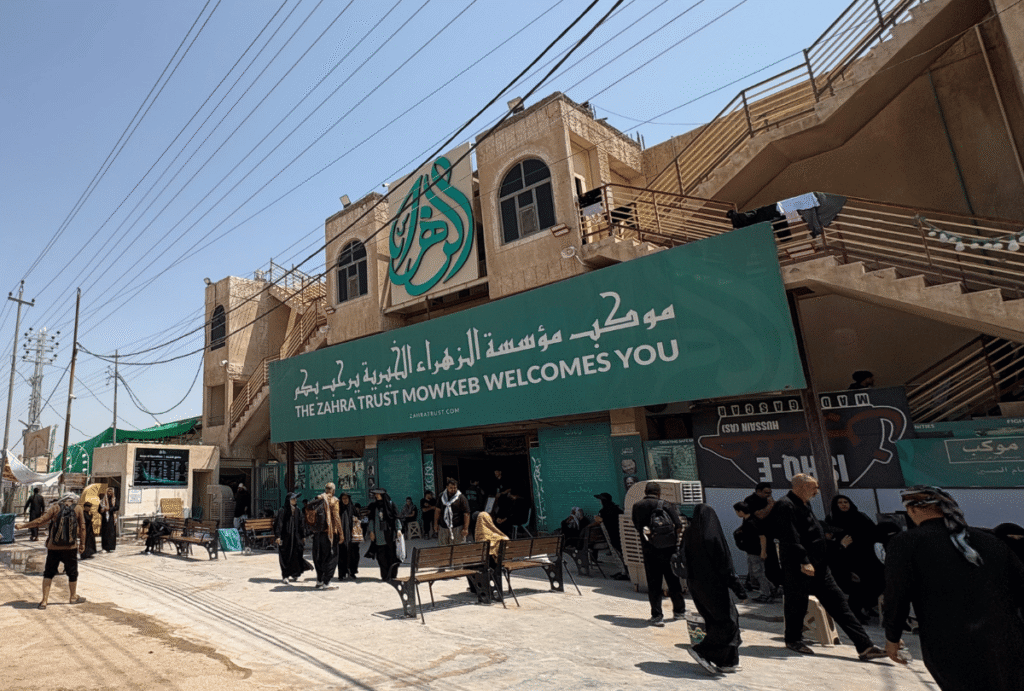
Mowkebs, or mawakeb, aare volunteer-run service and mourning stations that support pilgrims throughout Arbaeen. They provide essentials such as food, water, rest spaces, medical assistance, and practical care. Yet their purpose extends far beyond logistics.
Mowkebs represent one of the most visible expressions of Hussaini hospitality. They transform remembrance into action and devotion into service. Every meal prepared, every cup of water offered, and every act of care reflects a desire to honor Imam Hussain (as) through serving others.
For many pilgrims, mowkebs become one of the most memorable parts of the journey because they embody the spirit of generosity that defines Arbaeen.
Where the meaning of mowkebs comes from
Today, during Arbaeen, mowkebs stand along the route between Najaf and Karbala and welcome pilgrims regardless of nationality, language, age, or background.
This tradition reflects a deeply rooted Islamic understanding that giving is not diminished by being shared.
Allah (swt) says:
This verse speaks directly to the spirit behind mowkebs. Service often happens quietly, consistently, and without expectation of recognition.
Another verse reinforces the spiritual value of giving:
For many who serve in mowkebs, these values remain at the heart of why they give.
From restriction to revival: The journey of mowkebs
There were periods in recent history when Arbaeen gatherings and public religious expression faced severe restrictions. During the rule of Saddam Hussein, both the Arbaeen walk and the establishment of mowkebs became prohibited.
Following 2003, communities rebuilt this tradition with extraordinary determination.
What emerged was not simply a return to previous practices. It became one of the world’s most significant examples of volunteer-driven service, where entire communities organize themselves around caring for pilgrims.
Today, thousands of mowkebs support millions of visitors throughout the journey to Karbala.
How service became a form of devotion
One of the defining characteristics of mowkeb culture is the belief that caring for others is itself an act of worship.
The services provided may appear simple, but they carry deep spiritual meaning:
Meals and refreshments
Drinking water
Rest and sleeping areas
First aid and medical care
Foot support and mobility assistance
Religious guidance and gatherings
The tradition reflects teachings found throughout Islamic sources.
The Prophet (saww) is reported to have said, “No sooner does a Muslim serve a group of Muslims than Allah (swt) will give him servants equal in number (to the group) in Paradise.”(Al-Kafi, v.2, p.307, n.1)
This hadith reminds believers that service is never ordinary. Acts of care become opportunities for spiritual growth.
Imam Ali (as) is also reported to have said, “The nourishment of the body is food whilst the nourishment of the soul is feeding others.” (Mishkat al-Anwar, n.325)
Mowkebs bring both meanings together by nourishing people physically and spiritually.
Serving through the example of the Ahlulbayt (as)
The tradition of service has deep roots in the example set by the Ahlulbayt (as).
Throughout Islamic history, the family of the Prophet (saww) demonstrated generosity not as an occasional act, but as a way of life. Their care for others extended beyond moments of ease and remained consistent even during hardship.
Imam Hussain (as), whose sacrifice is remembered during Arbaeen, embodied dignity, generosity, and responsibility toward others.
Mowkebs continue this example in a practical way.
People prepare meals before dawn, stand for hours to assist pilgrims, and offer what they have without expecting repayment. In doing so, they participate in a tradition that reflects values carried forward from generation to generation.
This understanding helps explain why service during Arbaeen continues to inspire millions.
The Zahra Trust Mowkeb
While mowkebs remain most visible in Iraq, the values behind them reach far beyond one location.
At The Zahra Trust, supporting zuwar during Arbaeen is one way we participate in this tradition of collective service.
Through this effort, we help provide:
Fresh meals and clean water
Rest and recovery spaces
First aid and practical support
Assistance for pilgrims from diverse communities
For us, this work is about more than meeting physical needs.
It is about honoring Imam Hussain (as) through care, compassion, and hospitality.
Each year reminds us that the Arbaeen journey is strengthened not only by those who walk, but also by those who serve.
Why mowkebs continue to matter today
Mowkebs show what becomes possible when people come together around a shared purpose.
In a world that can often feel disconnected, these spaces demonstrate generosity at scale. They remind us that faith is not only remembered through words but expressed through action.
Mowkebs continue to preserve a culture where dignity, equality, and service remain central.
Their impact reaches beyond the pilgrimage itself and leaves behind a powerful example of how communities can care for one another.
Serving the pilgrims of Hussain (as)
The tradition of mowkebs reminds us that Arbaeen is not only a journey of remembrance. It is also a movement of compassion, generosity, and collective service.
Every act of hospitality helps carry forward the values of Imam Hussain (as), ensuring that pilgrims are supported along every step of the journey.
Serve the path of Hussain (as).
Through supporting mowkebs and Arbaeen giving, we can continue this tradition of care and help ensure that the journey remains accessible, welcoming, and sustained for generations to come.
Frequently asked questions
What is a mowkeb in the Arbaeen pilgrimage?
A mowkeb is a volunteer-run service station that supports pilgrims during the Arbaeen journey by providing food, water, rest areas, and practical assistance.
Who runs mowkebs?
Mowkebs are organized by volunteers, families, local communities, and charitable organizations dedicated to serving pilgrims.
Are mowkebs only found in Iraq?
Although they are most commonly associated with Iraq, the values and traditions behind mowkebs have inspired similar efforts in communities around the world.
What services do mowkebs provide?
Typical services include meals, water, accommodation, medical support, foot care, transportation assistance, and religious gatherings.
Why are mowkebs important?
Mowkebs reflect devotion to Imam Hussain (as) and embody the values of sacrifice, hospitality, remembrance, and service.
Can international visitors access mowkeb services?
Yes. Mowkebs welcome pilgrims from all backgrounds and often provide support across multiple languages and cultures.
More from Blog
Why school meals matter more than you think
For many children, school represents more than a classroom. It is a place of safety, opportunity, and hope. For millions of children…
5 Quran Verses About Knowledge and What They Teach Us
Knowledge is one of the greatest blessings Allah (swt) has given humanity. Through knowledge, we strengthen our faith, deepen our understanding of…
Education in Crisis: When Conflict Steals the Classroom
Conflict doesn't only destroy buildings—it can also steal a child's future. For millions of children around the world, war and displacement mean…