
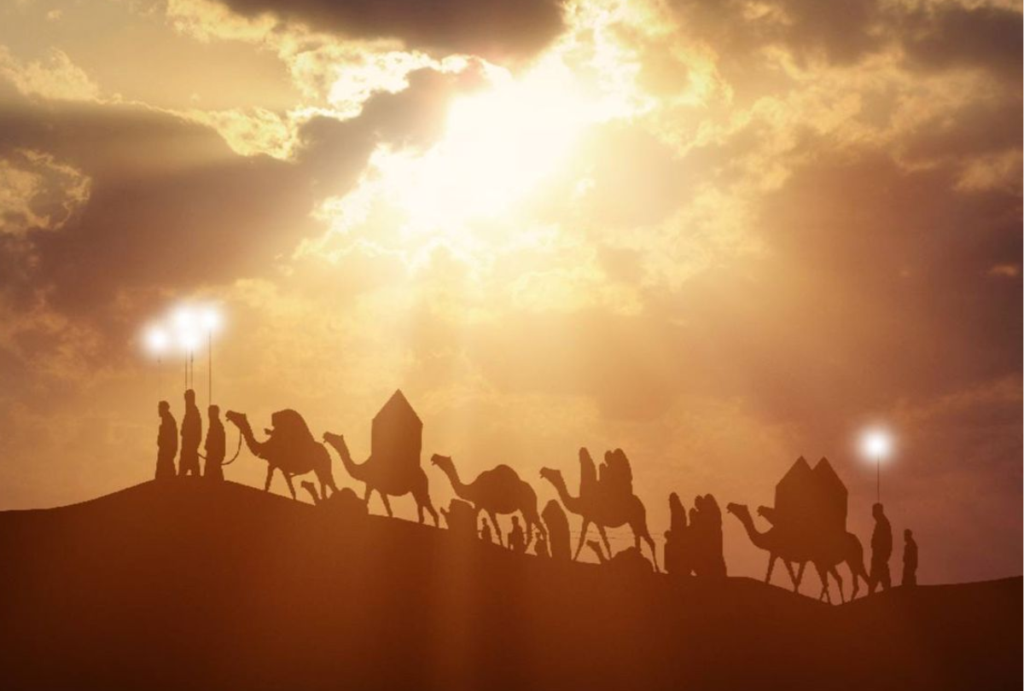
The tragedy of Karbala did not end on the plains where Imam Hussain (as) and his companions were martyred. It continued through a difficult and deeply emotional journey carried by the surviving members of the Ahlulbayt (as), mainly the women and children, who were taken into captivity.
This journey began in grief and oppression, moving from Karbala to Kufa, and then onward towards Shaam. It was a path marked by hardship, public display, and sorrow, but also one that carried truth, resilience, and unwavering faith in Allah (swt).
The journey from Shaam to Karbala, on the return route, later became a moment of remembrance and connection with the martyrs, often associated with Arbaeen and the reuniting of hearts with the land of sacrifice.
From Karbala to Kufa and beyond
After the events of Ashura, the surviving members of Imam Hussain’s (as) family were taken to Kufa. They were held briefly and then prepared for a forced journey towards Shaam under the rule of Yazid.
Historical accounts describe a long and exhausting route across the region, covering vast distances through Iraq and into Shaam. The caravan included women, children, and Imam Zain al-Abideen (as), who was severely ill at the time.
They were taken in conditions that reflected humiliation and grief, yet the dignity of the Ahlulbayt (as) remained unshaken. Even in captivity, they carried the message of Karbala forward.
The road to Shaam
The journey to Shaam was not only physical but deeply emotional. The caravan passed through towns and cities where the tragedy of Karbala became known to new audiences.
Sources describe how the captives were made to travel under harsh conditions, with limited provisions and exposure to the elements. Despite this, the message of truth began to spread far beyond Karbala itself.
Shaam, the capital of Yazid’s rule, became the place where the captives were publicly presented. This moment was intended to silence them, but instead it became a turning point where the message of Karbala reached the heart of the political centre.
In the court of Yazid
When the captives were brought into Yazid’s court, they were presented in a manner meant to humiliate and silence them. However, it was here that the strength of Ahlulbayt (as) became most visible.
Imam Zain al-Abidin (as) and Sayyida Zainab (sa) stood as voices of truth, speaking with clarity and courage in the face of oppression. Their words transformed the court from a place of power into a platform of testimony.
It was not silence that followed Karbala, but speech. It was not defeat, but endurance.
The voice of Sayyida Zainab (sa)
One of the most powerful moments of this journey is the sermon of Sayyida Zainab (sa) in the court of Yazid. Despite the grief she carried, she spoke with unwavering conviction:
This verse highlights the central place of the Ahlulbayt (as) in the message of Islam and the enduring nature of their sacrifice.
Loyalty through the example of the Ahlulbayt (as)
The journey of Sayyida Zainab (sa), Imam Zain al-Abideen (as), and the surviving family of Imam Hussain (as) reflects a profound form of loyalty and devotion.
Despite unimaginable loss, they remained steadfast in their mission to preserve the truth of Karbala. Their patience, dignity, and courage became a living example of faith under trial.
Imam Zain al-Abideen (as), even in his illness and grief, ensured that the message of his father was not lost. Sayyida Zainab (sa) carried the responsibility of leadership within the caravan, ensuring that the story of Karbala reached every place they passed.
Their example shows that faith is not only expressed in moments of ease, but also in the most difficult trials.
From history to the Arbaeen movement today
Today, the journey from Shaam to Karbala is not only remembered in history but lived through the millions who walk towards Karbala during Arbaeen.
This movement reflects devotion, unity, and service. It is a continuation of love for Imam Hussain (as), where people from across the world gather in remembrance and sacrifice.
Alongside the pilgrims are those who serve them, providing food, shelter, and care along the route. These acts of service reflect the spirit of the Ahlulbayt (as), where compassion and generosity stand at the heart of worship.
Let your giving walk beside them. Through supporting Arbaeen initiatives such as zuwaar support, mowkeb assistance, and wider humanitarian projects, you become part of a living legacy of devotion.
Final thoughts
The journey from Shaam to Karbala is more than a historical account. It is a story of endurance, truth, and unwavering faith in the face of oppression. From captivity to testimony, the Ahlulbayt (as) carried the message of Karbala across lands and generations.
Today, that message continues through those who walk towards Karbala and those who serve them with devotion.
Frequently Asked Questions
What happened after the tragedy of Karbala?
After the martyrdom of Imam Hussain (as), the surviving members of his family were taken into captivity from Karbala to Kufa and then towards Shaam, where they were presented before Yazid’s court.
Why is the journey to Shaam significant?
The journey to Shaam represents the continuation of the tragedy of Karbala and the beginning of its global message through the speeches and resilience of the Ahlulbayt (as).
Did the captives return to Karbala?
Many historical accounts mention that the captives passed through Karbala on their return journey to Medina and visited the graves of the martyrs, though details vary between sources.
What is the connection to Arbaeen?
Arbaeen marks the 40th day of remembrance for Imam Hussain (as) and is often associated with the return of hearts to Karbala, reflecting the enduring legacy of sacrifice and devotion.
More from Blog
Why school meals matter more than you think
For many children, school represents more than a classroom. It is a place of safety, opportunity, and hope. For millions of children…
5 Quran Verses About Knowledge and What They Teach Us
Knowledge is one of the greatest blessings Allah (swt) has given humanity. Through knowledge, we strengthen our faith, deepen our understanding of…
Education in Crisis: When Conflict Steals the Classroom
Conflict doesn't only destroy buildings—it can also steal a child's future. For millions of children around the world, war and displacement mean…