
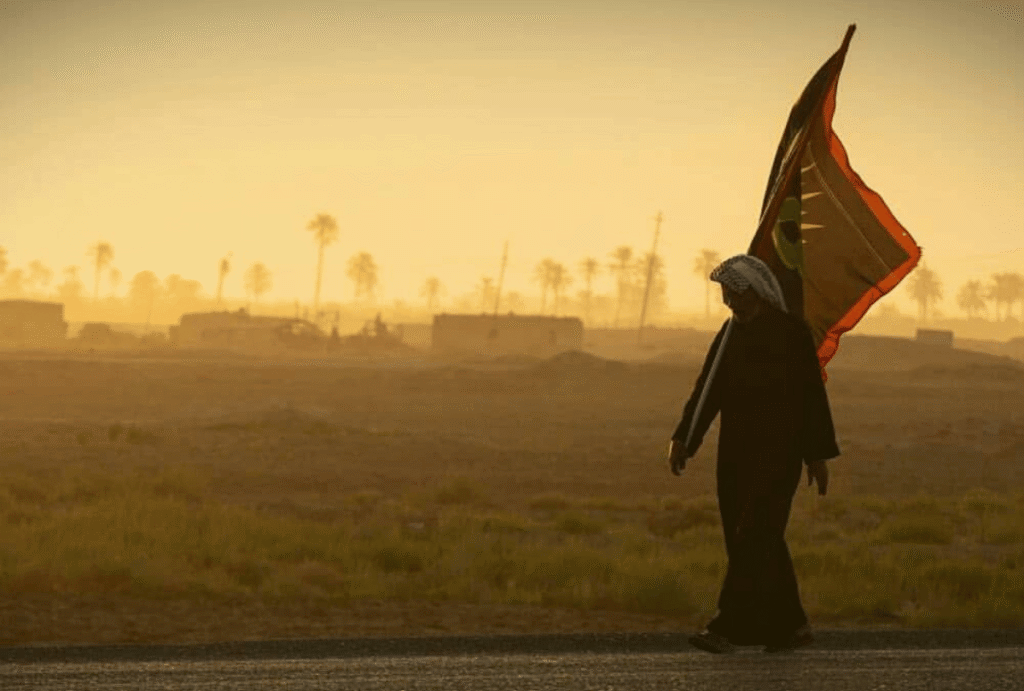
Forty days after Karbala, the tragedy had not become distant history.
The wounds of Ashura remained alive in the hearts of those who loved Imam Hussain (as). Yet the fortieth day became more than a continuation of grief. It became a day of visitation, remembrance, and renewed commitment.
This became known as Arbaeen.
Today, millions continue the journey to Karbala. But behind every step stands an earlier memory preserved in Shia tradition: the first Arbaeen, the earliest known ziyarat to Aba Abdillah (as), and the remembrance that the message of Karbala would never be left behind.
The meaning behind Arbaeen?
Arbaeen means “the fortieth” and marks the fortieth day after the martyrdom of Imam Hussain (as).
For Shia Muslims, this day developed into something far greater than a date of mourning. Arbaeen became connected to ziyarat, the act of visiting and remembering Imam Hussain (as), and expressing loyalty to the values for which he sacrificed everything.
The significance of Arbaeen is not found in counting days alone.
It reflects the understanding that Karbala did not end when the battle ended.
This connection to the Ahlulbayt (as) is reflected in the Quran:
Arbaeen became one of the most visible expressions of that love through remembrance, devotion, and continued allegiance.
Jabir and the first ziyarat of Karbala
Jabir, a companion of the Holy Prophet (saww), is widely remembered as the first known visitor to the grave of Imam Hussain (as). Accounts commonly describe him arriving in Karbala with Atiyya al-Awfi on the twentieth of Safar.
His journey is remembered because it transformed sorrow into witness.
At Imam Hussain’s (as) grave, Jabir is reported to have called out the Imam’s (as) name three times.
Jabir is then reported to have said, “Why a loved one does not answer one who loves him?”
He answers himself by reportedly saying, “How can he answer while his cheeks are torn, his head separated from his body?”
These words continue to resonate because they show that Arbaeen was never simply about mourning. It was about refusing to let Imam Hussain (as) be forgotten.
The return of the Ahlulbayt (as): Tradition and historical discussion
Another powerful part of the first Arbaeen narrative is the reported return of the family of Imam Hussain (as) to Karbala.
Many narrations describe that after leaving Shaam, they passed through Karbala and revisited the graves of the martyrs before returning toward Medina.
These narrations carry deep emotional significance and remain an important part of devotional memory.
For that reason, this event is best understood as a cherished tradition within Shia history while recognizing that scholars continue to examine the historical details.
What remains undisputed is the meaning behind it: the story of Karbala did not end with captivity.
When remembrance becomes movement
The first Arbaeen teaches something unique.
Ashura showed sacrifice.
Arbaeen showed continuation.
The battle ended, but the mission remained.
The earliest visitors to Karbala did not come with political authority or worldly influence. They came with love and loyalty.
That same spirit continues today.
Arbaeen is not only about remembering what happened in 61 AH. It is about asking whether the values of Karbala still shape how we live, serve, and respond to injustice.
This is why Arbaeen remains active rather than historical.
Carrying forward the example of the Ahlulbayt (as)
The Ahlulbayt (as) demonstrated that preserving truth requires perseverance.
Imam Zain al-Abideen (as) carried the message of Karbala after surviving the tragedy.
Lady Zainab (sa) ensured that oppression would not control the narrative of what happened.
Through patience, witness, and devotion, they protected the legacy of Imam Hussain (as).
The first Arbaeen reflects this same lesson.
Loyalty is not passive.
To remember Aba Abdillah (as) means allowing his values to influence our actions, our service, and our relationship with others.
Every sincere act done in service becomes part of a living tradition.
Arbaeen in our time
Over generations, Arbaeen developed into one of the largest annual acts of religious remembrance in the world.
People travel from across countries and cultures.
Many walk.
Many host.
Many give.
Many support pilgrims and communities along the way.
The scale may have changed, but the heart of Arbaeen remains the same.
People continue answering the call of loyalty that began with remembrance and became movement.
Let your giving walk beside them
The first Arbaeen reminds us that grief was never meant to remain still.
Through ziyarat, remembrance, and devotion, the message of Imam Hussain (as) continued.
Whether through the first pilgrimage of Jabir ibn Abdallah al-Ansari or the cherished memory of the Ahlulbayt (as) returning to Karbala, Arbaeen became a declaration that Karbala would live on.
Today, millions journey towards Imam Hussain (as).
Support the people and communities serving this extraordinary movement.
Let your giving walk beside them.
Serve the path of Hussain (as) and continue a tradition built on remembrance, devotion, and service.
Frequently asked questions
What is the first Arbaeen?
The first Arbaeen refers to the fortieth day after the martyrdom of Imam Hussain (as). It is remembered through the earliest ziyarat to his grave and the traditions connected to the continued remembrance of Karbala.
Who was the first person to visit Imam Hussain’s (as) grave?
Jabir ibn Abdallah al-Ansari is widely recognized in tradition as the first known visitor to the grave of Aba Abdillah (as) during Arbaeen.
Did the Ahlulbayt (as) return to Karbala on Arbaeen?
Many Shia narrations describe the Ahlulbayt (as) returning through Karbala after captivity, while historians continue to discuss the certainty of the exact historical timeline.
Why is Arbaeen important?
Arbaeen represents remembrance, loyalty, and carrying forward the message of Imam Hussain (as). It became associated with ziyarat and continued devotion after Ashura.
Why do people walk to Karbala for Arbaeen?
Walking to Karbala is understood as an expression of devotion, remembrance, and solidarity with the sacrifice and mission of Imam Hussain (as).
More from Blog
Why school meals matter more than you think
For many children, school represents more than a classroom. It is a place of safety, opportunity, and hope. For millions of children…
5 Quran Verses About Knowledge and What They Teach Us
Knowledge is one of the greatest blessings Allah (swt) has given humanity. Through knowledge, we strengthen our faith, deepen our understanding of…
Education in Crisis: When Conflict Steals the Classroom
Conflict doesn't only destroy buildings—it can also steal a child's future. For millions of children around the world, war and displacement mean…