
The decision that saved Islam: Imam Hasan (as) and the wisdom of peace treaty
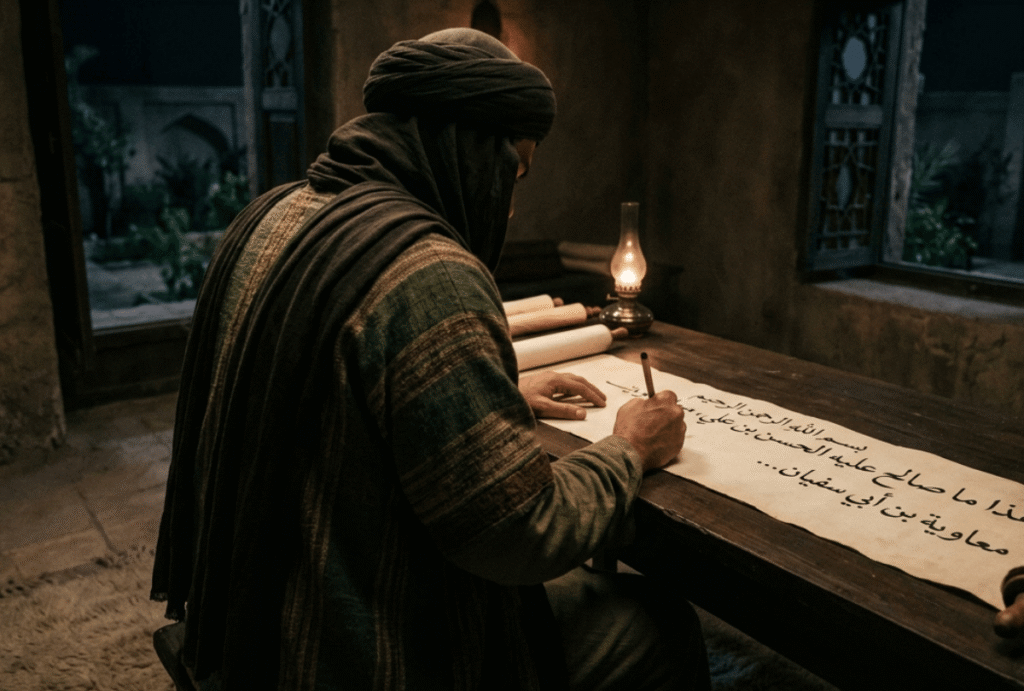
Not every victory in Islam comes through battle.
Some of the most defining moments in Islamic history are marked not by fighting, but by wisdom, patience, and courage under pressure.
One of the clearest examples is the decision of Imam Hasan (as) to enter into a peace treaty with Muawiyah.
At the time, many people did not understand it. Some even questioned why the grandson of the Prophet Muhammad (saww) would step back from leadership.
But history shows this was not retreat – it was protection.
Allah (swt) says in the Holy Qur'an:
“And reconciliation is best.” (4:128)
A Choice Few Understood
When Imam Hasan (as) agreed to the peace treaty, the Muslim community was deeply divided.
His forces were weakened, trust had broken within his ranks, and continuing conflict risked major bloodshed among Muslims.
Many saw the decision as weakness.
But in reality, it required immense courage.
Imam Hasan (as) chose to protect the Ummah rather than pursue a destructive civil war.
Protecting the ummah
The situation Imam Hasan (as) faced was critical.
Continuing the conflict would have resulted in widespread loss of life and deeper division within the Muslim world.
The peace treaty was not surrender.
It was a decision to prevent chaos and preserve the future of Islam.
Exposing the truth
The treaty contained conditions intended to uphold justice and accountability.
When those conditions were broken, the truth about Muawiyah’s rule became clear to many who were uncertain.
Imam Hasan (as)’s decision revealed reality without plunging the Muslim world into further violence.
In doing so, he protected the message of Islam for generations to come.
Different paths, one mission
Imam Hasan (as) and Imam Hussain (as) are often studied together.
Both stood for truth. Both resisted oppression. Both protected Islam.
But their methods were different.
Imam Hasan (as) protected Islam through peace and patience.
Imam Hussain (as) later protected it through sacrifice and resistance.
Different circumstances, one unified mission.
A legacy of wisdom
Imam Hasan’s (as) peace treaty teaches a powerful lesson.
Strength is not always shown through confrontation.
His decision remains one of the most important moments in Islamic history—one that preserved the foundation of Islam itself.
Frequently asked questions
Why did Imam Hasan (as) agree to a peace treaty?
He agreed to prevent civil war among Muslims and to protect the unity and survival of Islam.
Was Imam Hasan (as) in a strong military position?
No. His supporters were divided, and there was significant betrayal within his own ranks.
Did the treaty mean Imam Hasan (as) gave up leadership?
No. It was a strategic decision to protect Islam, not a surrender of principles.
What was the purpose of the treaty?
To stop bloodshed, preserve the Muslim community, and prevent further internal conflict.
How does Imam Hasan (as) connect to Imam Hussain (as)?
Both Imams (as) worked to preserve Islam, but through different methods based on their circumstances.
What lesson does this teach today?
It teaches that wisdom, patience, and long-term thinking can sometimes be the strongest form of leadership.
More from Blog

Why school meals matter more than you think
For many children, school represents more than a classroom. It is a place of safety, opportunity, and hope. For millions of children…

5 Quran Verses About Knowledge and What They Teach Us
Knowledge is one of the greatest blessings Allah (swt) has given humanity. Through knowledge, we strengthen our faith, deepen our understanding of…

Education in Crisis: When Conflict Steals the Classroom
Conflict doesn't only destroy buildings—it can also steal a child's future. For millions of children around the world, war and displacement mean…