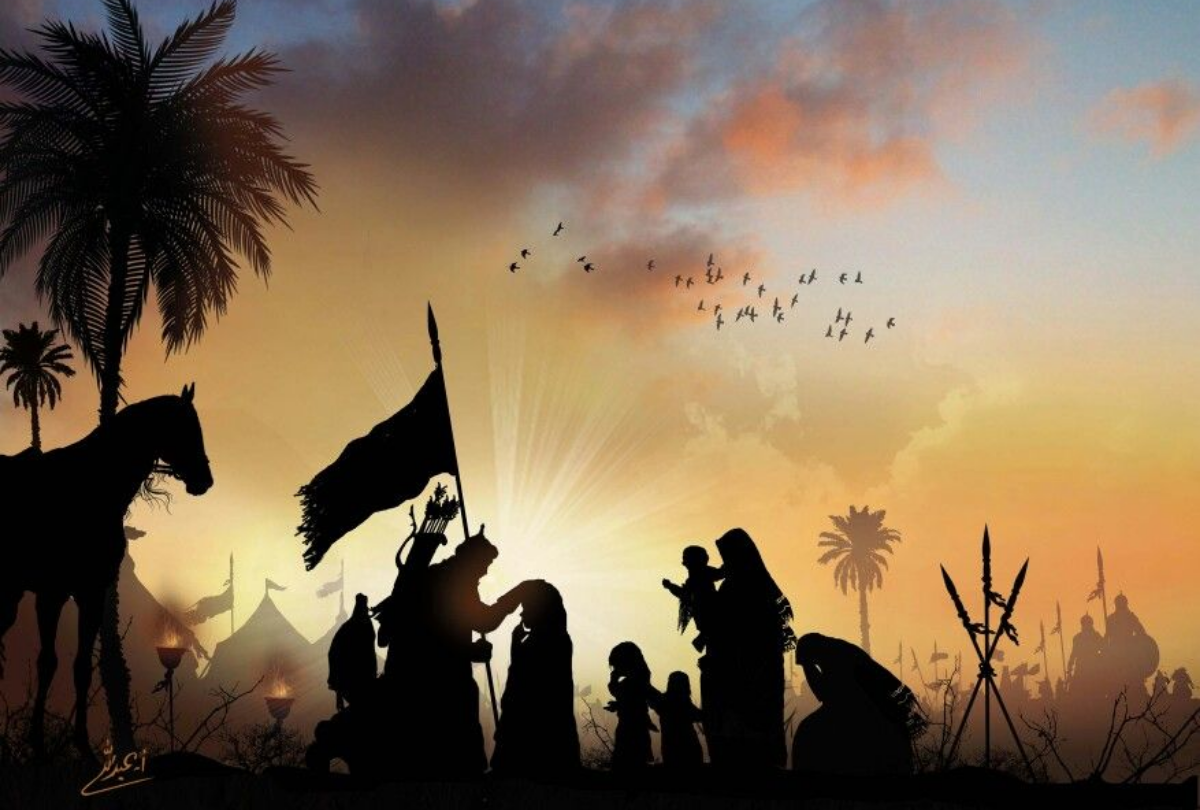
Karbala: The Ultimate Example of Sacrifice and Loyalty
Karbala is remembered as one of the most powerful moments of moral resistance in Islamic history.
It is not simply a historical event but a story that continues to shape discussions about justice, truth, and human dignity.
In 680 CE (61 AH), Imam Hussain (as), the grandson of Prophet Muhammad (saww), made a decision that would define his legacy forever.
He refused to pledge allegiance to Yazid (la), whose rule was seen as unjust and corrupt.
This refusal was not political ambition, but a stand for principle.
The message of Karbala is often reflected through the Quranic reminder of peace and return to God:
“O the peaceful soul! Return unto your Lord while you are well pleased (with Him) and well-pleasing (to Him), and enter among My servants, and enter My Paradise!”
Surah Al-Fajr, Ayahs 27-30
These verses are frequently associated with those who remain steadfast in faith and sacrifice for truth, including Aba Abdillah (as) and the martyrs of Karbala.
The Stand of Imam Hussain (as): Sacrifice for Truth
Imam Hussain (as) knew the consequences of his journey to Karbala.
He was aware that his group was small and the opposing force was large, yet he chose not to compromise on justice.
His stand was rooted in preserving the moral foundation of Islam rather than accepting political pressure.
Even when survival was uncertain, he refused to legitimize oppression.
The emotional impact of his sacrifice is reflected in the words of the Prophet (saww):
“Surely, there exists in the hearts of the believers, with respect to the martyrdom of Hussain (as), a heat that never subsides.”
Mustadrak al-Wasail, v.10, p.318
This continues to explain why Karbala remains deeply significant for believers today.
Loyalty of the Companions
The companions of Imam Hussain (as) displayed a level of loyalty that is remembered across generations.
They stood with him despite knowing the outcome, showing that their commitment was not based on hope of victory, but on truth itself.
Imam Hussain (as) is reported to have said:
“I know no companions more worthy, nor better, than mine, nor any members of a family more joining of the ties of kinship than my Ahlulbayt (as); so, may Allah (swt) reward all of you on my behalf.”
Maqtal al-Hussain
This statement highlights the depth of their unity, sincerity, and devotion.
Among them, Hazrat Abbas (as) holds a special place as a symbol of loyalty and self-sacrifice.
He is remembered for his attempt to bring water to the camp of Imam Hussain (as) during extreme thirst.
Despite having the opportunity, he refused to drink, prioritizing duty over personal need.
His story continues to represent unwavering loyalty under extreme hardship.
The Aftermath: When Silence Became Speech
The story of Karbala did not end on the battlefield.
It continued through those who survived and carried its message forward.
Sayyida Zainab (sa) played a crucial role in this continuation.
After the tragedy, she spoke in the courts of Kufa and Damascus, openly challenging injustice and refusing to let the narrative be controlled by those in power.
Her courage turned grief into testimony.
Imam Ali ibn Hussain (as), known as Imam Sajjad (as), also endured immense suffering while preserving the spiritual leadership of the family of the Prophet (saww).
His patience ensured that the message of Karbala remained alive for future generations.
Imam al-Sadiq (as) is reported to have said:
“As for Ali ibn Hussain (as), he cried over Hussain (as) for twenty years (after the tragedy of Karbala); never would any food be placed before him except that he would begin to weep.”
Bihar al-Anwar, v.46
This reflects the lasting emotional and spiritual impact of Karbala within the Prophet’s (saww) household.
Core Lessons from Karbala
Karbala continues to offer lessons that remain relevant across time and place:
- Standing for truth even when isolated
- Rejecting injustice in all forms
- Prioritizing principle over personal safety
- Defining loyalty as commitment to righteousness
- Turning patience into strength during hardship
These lessons show that moral victory is not always about survival, but about remaining firm in conviction.
A Legacy That Never Fades
Karbala is more than a historical tragedy.
It is a timeless lesson about truth, loyalty, and moral courage.
The stand of Imam Hussain (as), the devotion of his companions, and the endurance of Sayyida Zainab (sa) and Imam Sajjad (as) together form a legacy that continues to inspire reflection and action today.
It reminds us that real victory is not measured by survival, but by staying faithful to what is right, no matter the cost.
Frequently Asked Questions
Karbala is important because it represents Imam Hussain’s (as) stand against injustice and his commitment to preserving truth, even at great personal cost.
His message was to uphold justice, resist oppression, and protect the true values of Islam regardless of consequences.
Hazrat Abbas (as) was the brother of Imam Hussain (as) and Sayyida Zainab (sa). He is remembered for his loyalty, bravery, and selflessness during the events of Karbala.
Sayyida Zainab (sa) preserved the message of Karbala by speaking out against injustice in Kufa and Damascus, ensuring the truth was not silenced.
Karbala is remembered because its message of sacrifice, loyalty, and justice continues to inspire people worldwide to stand against oppression.
It teaches patience, courage, loyalty, and the importance of standing firm on truth even in the face of overwhelming difficulty.